Showing posts with label Grimm Tales. Show all posts

Tuesday, 30 November 2010

Practice Makes Perfect!


I decided to make a very simple model to give me a better idea of what I'm working with, although still difficult as I don't have any stage measurements yet! This exercise really helped me visualise and see things coming together, as well as pointing out simple issues. For example, its now clear that the step down into the 'adaptable area' may not work as it doesn't leave a lot of room around the ring, although would the actors need room there? This is something I would normally discuss with actors and the director but in this case I have to decide for myself.

I have included photo's above of the process of making the model tree which went okay for a first attempt. I have since found an image sheet of tree silhouettes so I can choose a shape appropriate for the period, location and that will fit in the set.

Dummling Costume #1


The previous image labelled ‘ordinary peoples clothing’ gave me the starting point I needed for Dummling’s clothing, it also helped me plan the ‘sisters from the Inn’s attire.

Reflection on Narrative and Tudor Life

By placing this dramatisation in the Tudor period, an obvious character to base the Princess on would be Elizabeth I. This production could be like a ‘what if’ view on Elizabeth’s life as she famously never got married as she claimed to be married to her country. An even more obvious choice would be her half-sister Mary as she was renowned for being serious and having an attitude, which is the description of the Grimm character. This choice will have a huge effect on both the design on the production and the narrative because of the difference in religion. Mary was a catholic so her wedding ceremony, clothing and props would all be different to that of her protestant half-sister.


The image above shows a high class man and woman dressed ‘according to their stations in life’. Tudor fashion was very much based on social class and trying to dress better than your class in order to progress through the classes. There was a lot of detail and, as the text above suggests, the fashions changed very quickly as people were very keen to be wearing the next big thing to state their rank.

Monday, 29 November 2010

Initial Idea's

I finally have the internet! So I can get everything on here now, only trouble is that the pictures don't want to move so i'm going to have to post lots of little posts to get it on here until I find a way to sort it.

It all starts with Carol Ann Duffy's dramatisations of the Grimm Tales, which I read through and, with my background being in film, really struggled to visualise as any kind of theatre production. In my head I was switching camera angles and locations like a film would which obviously would not work on a stage.

The only story I seemed to have any ideas for was The Golden Goose, which I had never heard of before so I decided to take this story as a basis for my work and see what I could build up.

TUDOR

As I have been interested in this period of history for as long as I can remember I have decided to look into this further to use as a genre for this project. Over the years I have collected quite a few books on this period, some focusing on the architecture, some on the clothing and others on social issues around the reigns of Henry VIII and Elizabeth I.

From breaking down the script, I decided to focus on the last 3 scenes. In these scenes, Dummling and his followers arrive the Great City and make the Princess laugh. Which results in Dummling and the Princess getting married in the final scene.

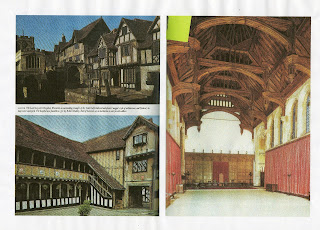
When applying this scene to the Tudor period, I figured that the visitors would have been greeted in the Great Hall by appointment and then the marriage could have taken place in either the Great Hall, the chapel or a nearby church. I began researching Tudor architecture and sketching designs for the Great Hall set.


Panelling is a key element in Tudor architecture, interior and exterior.