Princess has her hair down, prepared for marriage.

Simple fabrics, no embellishment but Tudor silhouettes

 I found this cut out in an old book I was given as a child on the Tudors. It explains the popularity of a fictional faerie character based on Elizabeth I. I have looked for more evidence of this character but can only find that the character came about through a poem written by Edmund Spenser and that various artists incorporated the character into their paintings, all with different idea's of aesthetics.
 This image is inspiring because the pattern and colours show similarities to the fabrics used to make Tudor gowns, particularly towards the end of the 16th century when everything became more detailed and decadent. Taking this texture and applying it to face has made me think about where I am using particular colours, textures, patterns and shapes and whether I should mix it up a little to see what happens.


The previous image labelled ‘ordinary peoples clothing’ gave me the starting point I needed for Dummling’s clothing, it also helped me plan the ‘sisters from the Inn’s attire.


The volume in the sleeves also moved over the century from a lot of flare around the cuffs so an undergarment can be seen to the volume being around the shoulder and a very tight cuff around the wrist.

My research tracings show the difference in detailing over the 1500’s. The early Tudor detailing is bold and uses a lot of pearls and beading whereas later in the century the detailing is a lot finer and more than one luxurious material is used for example pearl, lace and velvet all on one garment.

The image above shows a high class man and woman dressed ‘according to their stations in life’. Tudor fashion was very much based on social class and trying to dress better than your class in order to progress through the classes. There was a lot of detail and, as the text above suggests, the fashions changed very quickly as people were very keen to be wearing the next big thing to state their rank.

This image shows the previous design with the overlay down. The overlay explains where detail would be, idea’s I am thinking of and character’s movement.


I started out by planning very simple ‘court’ scenes, taking inspiration from ‘The Tudors’ television production by having an elevated platform with just the two thrones and a table.
I felt that it needed more layers, more differences in height so I went on to design the next image.
It all starts with Carol Ann Duffy's dramatisations of the Grimm Tales, which I read through and, with my background being in film, really struggled to visualise as any kind of theatre production. In my head I was switching camera angles and locations like a film would which obviously would not work on a stage.
The only story I seemed to have any ideas for was The Golden Goose, which I had never heard of before so I decided to take this story as a basis for my work and see what I could build up.
TUDOR
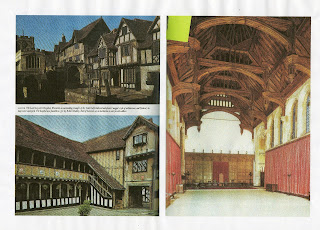
As I have been interested in this period of history for as long as I can remember I have decided to look into this further to use as a genre for this project. Over the years I have collected quite a few books on this period, some focusing on the architecture, some on the clothing and others on social issues around the reigns of Henry VIII and Elizabeth I.
From breaking down the script, I decided to focus on the last 3 scenes. In these scenes, Dummling and his followers arrive the Great City and make the Princess laugh. Which results in Dummling and the Princess getting married in the final scene.
When applying this scene to the Tudor period, I figured that the visitors would have been greeted in the Great Hall by appointment and then the marriage could have taken place in either the Great Hall, the chapel or a nearby church. I began researching Tudor architecture and sketching designs for the Great Hall set.